
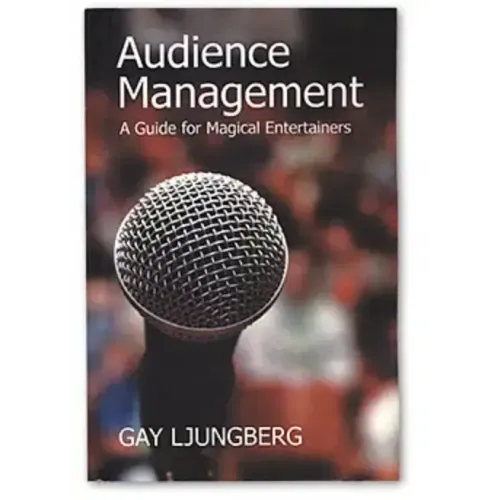
Audience Management: A Guide for Magical Entertainers by Gay Ljungberg
Original price was: $27.96.$3.99Current price is: $3.99.
Description
A Guide for Magical Entertainers
In this book, Gay Ljungberg shares his performing experience with the reader and reveals a treasure of valuable secrets, about the psychology and the techniques he uses. He teaches you how to select assistants from the audience and how you turn them into instant actors to play with on stage. You will learn how to conquer your stage fright, how to connect with your audience and how to design a strategy for success. You will also discover the secrets of crowd control and stage presence.
Whether you are a performing magician, clown, juggler, ventriloquist, or stand in front of an audience for any other reason; you can improve your act by reading this book.
“i want the reader to become a better performer, by focusing on the audience and learning to connect and communicate.” – Gay Ljungberg
Pages: 143 – Softbound
Magic book reviews
Audience Management: A Guide for Magical EntertainersAudience ManagementIN A SENTENCE: Man, I wish I’d had this book back when I was getting ready to take my first baby steps onto that shiny stage.Now, picture this. I used to think I was the audience management wizard, not just as a pro close-up magician but especially from my days as a magic bartender. I mean, that job was as much about handling the crowd as it was about doing magic tricks. But boy, was I in for a surprise! Turns out, managing an audience from the stage is a whole different ballgame. As the late great Billy McComb used to say, “You gotta learn to make friends with darkness.” When you’re up there on that stage, trying to wrangle, control, and manage what and who is sitting out there in that big ol’ darkness, it’s like having a special superpower that only comes from years of being in the trenches.Luckily for us all, Swedish magician and clown Gay Ljungberg has been there, done that, and got the T-shirt. His book is like a magic compass that’ll help any aspiring performer save time and dodge some of those pesky pitfalls on the road to mastering those oh-so-important skills. It’s a thoughtful and super convincing guide to the many-sided circus that is a performer’s relationship with their audience.I knew this book was gonna be a winner when I laid eyes on a sentence on the first page. It was trying to define “audience” in a way that’s way cooler than just a bunch of people sitting in seats. “The individuals become a collective when they experience an emotion simultaneously.” Now that’s one heck of an observation about audiences!So, Mr. Ljungberg gets down to business and tackles the questions performers need to ask themselves if they want to come up with and pull off an effective plan for creating those emotional roller coasters. It’s a fascinating and challenging mission, the real deal in the performance arts world. And this author has a ton of insightful tips to offer that go from deep-thinking artistry to down-to-earth pragmatics. He says, “If you manage that audience right, they’ll usually do what you want. And if they don’t, you can still turn it around and make it work for your show.” That’s like the mission statement of this book, and he goes after it with gusto and artistic flair, all while keeping an eye on the real world. And just when you think it can’t get any better, he follows up with this zinger: “Shit happens, but remember that manure is a fertilizer.”In another part, the author is like, “Hey, you! Reorient your priorities!” He wants performers to shift their focus away from themselves, their scripts, their props, and their beloved magic tricks and instead aim it at the experience their audience will have when they watch the show. I’d like to add that while the author says “instead,” I think all those things he mentioned are super important. But often, the difference between an amateur magician and a pro, especially the really good ones, is when they look beyond themselves and realize they gotta serve the audience’s needs as well as their own.Mr. Ljungberg spends some quality time helping performers figure out their own clear mission statement about what they want to achieve with their audience. He asks important questions like what you want your audience to experience, feel, learn, and how you want them to react. Then he takes a look at all the tools we can use to reach those goals, like scripts, effects, routines, methods, props, stage set, lighting, music, sound, and more.There’s an extended section called “Homo Ludens” (that means playful humans). It’s all about the nature of play and how it relates to magic. I gotta agree that magic is like adult playtime – interactive, creative, and full of imagination. The author explores a bunch of playful situations that he sees as games between the audience and the performer.These game scenarios could be really useful for theatrical clowns (not just the ones at the circus or for birthday parties) and for kids’ performers. There are definitely examples here that can work with more traditional performance styles and adult audiences too. But you can see Mr. Ljungberg’s unique perspective in this discussion about games. While I don’t disagree with what he’s saying, I’d also point out that it’s far from the whole story when it comes to magic. The author is clearly focused on comedic and “fun” games, but for some of us, magic can sometimes be dramatic and focus on the mystery. These aspects of magic aren’t really talked about. Not because the author would disagree, but probably because it’s not his artistic cup of tea. Sometimes magic can be provocative, serious, and earnest. That’s the nature of mystery, and that’s the nature of magic too. True, a lot of magicians might ignore these artistic paths. But in my opinion, that’s a shame.To give Mr. Ljungberg his due, he’s really upfront about where he’s coming from. “You might not agree with me,” he says. “But at least try to understand what I’m getting at. You can always choose your own path anyway.” Asking the reader to understand before they disagree is all any smart writer can hope for.Another part of the book looks at the “invisible contract” between performer and audience and how the performer defines their role as “magician.” The author’s ideas about his role are similar to mine, but others might not agree. But the important thing is that defining what magic and being a magician mean is a crucial step for every performer on the road to becoming a great conjurer. And too often, not many people take that step.After all that deep thinking and artistic talk, the author gets down to the nitty-gritty of craft. He talks about stage presence, how to beat stage fright, how to connect with people, crowd control (especially useful for kids’ performers), and business and administrative stuff that can help make a performer successful. One of my favorite chapters is about managing on-stage assistants. The author gives some amazing advice here that beginners can use to save themselves a lot of grief and stage disasters. Like how to choose assistants, get them on stage, and why you should never let your first volunteer say no. There’s nothing that screams “beginner” more than a magician asking for a volunteer. Mr. Ljungberg can help you avoid that and many other newbie disasters.If it seems like a lot of ground is covered in just 143 pages, well, that’s probably because the author knows his stuff. He took his time (several years, in fact) to write this book. He didn’t give us a bunch of boring rules or brag about himself. And he waited until he’d been performing professionally for more than 20 years before he decided to share his wisdom with us. In other words, he made sure he actually had something valuable to teach before he opened his mouth.
And speaking of teaching, the final chapter, “Learning Games,” describes eight group exercises that the author has used in training sessions for other performers. A lot of this will be new territory for magicians who don’t have much theater background. Mr. Ljungberg is really generous in sharing these tools. The local magic club would be way smarter to try these at their next meeting instead of spending another night doing the same old ring-on-rope tricks. (But the chances of that happening are pretty much zero.) Oh, and about “making friends with darkness,” Mr. Ljungberg suggests that whenever possible, you should turn up the house lights.
Related products
- Sale!Add to cart
- 2024, Instant Download, Magic Ebooks
Duraty – Close-Up Festival
- Original price was: $16.99.$3.99Current price is: $3.99.
- Sale!
- Sale!Add to cart

- 2024, Magic Ebooks
Best of Friends Vol 1 Harry Lorayne – Book
- Original price was: $23.00.$2.99Current price is: $2.99.
- Sale!
- Sale!Add to cart

- 2024, Instant Download, John Carey, Magic Ebooks, Rudy Tinoco
Gemini Production by John Carey & Rudy Tinoco
- Original price was: $9.99.$1.99Current price is: $1.99.
- Sale!
- Sale!Add to cart

- 2024, Magic Ebooks
Old Things Have Strange Hungers pt.2 By Silvia Stjarna
- Original price was: $21.00.$0.99Current price is: $0.99.
- Sale!